CRM pipeline stages: define the evidence to move forward

Sawsan Sayad
Sawsan Sayad covers enterprise systems, AI and business software for The Blue LED Global.
A CRM opportunity should move to its next stage when agreed evidence is present, not merely because someone completed an activity. Before configuring the pipeline, define what each stage means, which evidence permits progression, who maintains it and what happens when the evidence is missing. Keep the stage separate from the next task and the forecast judgment.
This is a practical design worksheet for sales teams introducing or revising CRM. The Blue LED's CRM implementation and sales operations service covers qualification, stages, ownership and forecasting inputs. The worksheet below is our proposed way to make those decisions explicit, not a description of a client deployment.
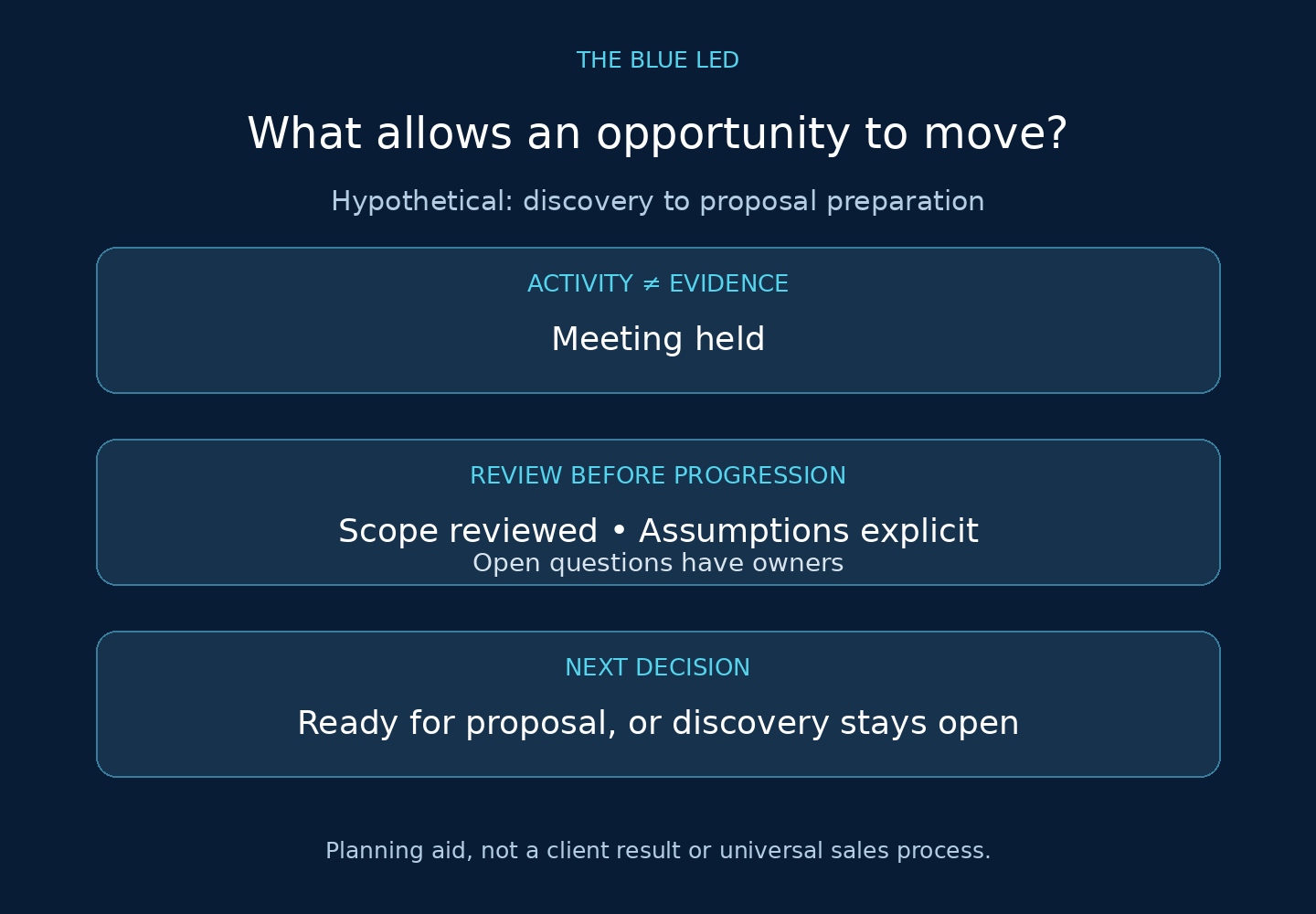
Hypothetical transition from discovery to proposal preparation: review evidence, not just completed activities.
Start with a decision, not a list of activities
“Meeting held” describes an event. It does not establish whether the customer has a problem you can address, whether the right people participated or whether a next step was agreed. “Proposal sent” similarly says little about whether its scope matches the customer's requirement.
For each stage, write one sentence beginning: “An opportunity belongs here when…” Then ask two salespeople to classify the same hypothetical opportunity independently. If their answers differ, resolve the definition before adding more fields. A longer pipeline does not repair an ambiguous one.
Keep lead qualification distinct from opportunity progression. A contact record, an enquiry and an active opportunity need not represent the same commercial commitment. Decide when a lead becomes an opportunity and who accepts ownership at that point.
Give every transition an evidence contract
The following is a hypothetical services-sales example. Replace its conditions with your sales model; it is not a universal funnel or a forecast formula.
| Transition | Evidence to review | Responsible owner | If evidence is missing |
|---|---|---|---|
| Enquiry to qualified opportunity | A specific business need, responsible customer contact and agreed discovery step | Sales owner | Continue qualification or record a disqualification reason |
| Discovery to proposal preparation | Reviewed scope, assumptions and unresolved questions assigned to owners | Sales owner with delivery input | Keep discovery open; do not present assumptions as agreement |
| Proposal to commercial review | Proposal version shared, customer feedback recorded and next decision identified | Sales owner | Record follow-up separately; sending a document is not acceptance |
| Commercial review to won | The organization's defined acceptance evidence and delivery handover inputs | Authorized sales owner | Keep the opportunity open or record the appropriate lost outcome |
The final row is an operating definition, not legal advice about contract formation. Your authorized commercial team must define the evidence it can accept. Do not turn this worksheet into automatic contract acceptance or revenue recognition.
For each transition, record the source of evidence, its date and any expiry or review condition. A note saying “confirmed” is weak if no one can tell what was confirmed or by whom. Collect only the information needed for the decision, with access appropriate to the people using it.
Separate a stage gate from a business approval
Microsoft documents that Power Automate business process flows can require a field before a user advances to another stage. It also distinguishes this guided progression from broader automation. That is a product-specific capability, not proof that every CRM edition behaves the same way. See Microsoft's business process flow overview.
A filled field proves that a value exists. It does not necessarily prove that a proposal was reviewed, that a manager authorized an exception or that delivery accepted the handover. Specify those decisions independently. Confirm supported validation, permissions and audit behavior for the actual platform and licensed edition before promising enforcement.
Use a required field only when its absence should genuinely block progression. Otherwise, users may enter placeholders just to continue. Classify inputs as required for this transition, useful for later work or optional context. Remove fields that have no named consumer or decision.
Design backward moves and exceptions now
A customer may revise scope after receiving a proposal. Decide whether the opportunity returns to discovery, stays in its stage with a visible exception or follows a separate process. Record the reason and retain the history needed to understand the change. Do not silently overwrite the previous basis for a forecast.
An owner on leave is another ordinary scenario. Define reassignment and escalation without giving every salesperson unrestricted access. For a multi-country rollout, distinguish a genuinely different sales process from a translated label. Arabic and English stage names should describe the same acceptance condition where the process is shared.
Keep stage, forecast category, expected close date and next activity separate in the design worksheet. A stage change should not automatically imply a new probability or date unless the business has expressly defined that rule and tested it. Do not invent conversion probabilities to make a dashboard look complete.
Test with uncomfortable examples
Use the testing, training and support plan to turn the stage definitions into realistic acceptance scenarios:
- A proposal exists, but the customer has not reviewed its scope. Can the user distinguish document delivery from commercial progress?
- A required field contains a placeholder. Does the agreed review detect it, or does the interface merely check that it is nonempty?
- An opportunity moves backward, changes owner or closes as lost. Are the reason, history and follow-up intelligible to the next person?
- The same scenario is entered in Arabic and English. Do the owners reach the same stage decision?
- A record arrives through an import or integration rather than the normal screen. Have you verified the relevant controls on that route instead of assuming the screen rules apply?
Retain expected results and actual evidence. Where a control is manual, describe it as manual. Where a route cannot enforce the rule, record the limitation and its owner before acceptance.
Finish with a small, usable stage dictionary
Deliver one versioned dictionary containing stage meaning, entry and exit evidence, field ownership, exception handling and the reporting interpretation. Have sales and delivery owners try it against a few representative scenarios before configuration begins. Revisit disputed definitions during the pilot rather than adding fields reflexively.
A useful CRM pipeline lets the next person explain why an opportunity is in its stage and what decision is needed next. That is a more practical acceptance test than whether every column on the board contains a card.
Sources
Sources checked 14 November 2026. Product capabilities must be confirmed for the selected platform and licensed edition. The worksheet and hypothetical examples are editorial recommendations.