ERP changes: configure, customize or integrate?

Sawsan Sayad
Sawsan Sayad covers enterprise systems, AI and business software for The Blue LED Global.
Choose configuration when documented settings meet the business requirement. Consider a supported extension when a valuable gap needs additional logic, and integration when another system should keep responsibility for a capability or authoritative record. A single process may need all three. The useful decision is where each rule belongs, who owns its data and who will maintain the result.
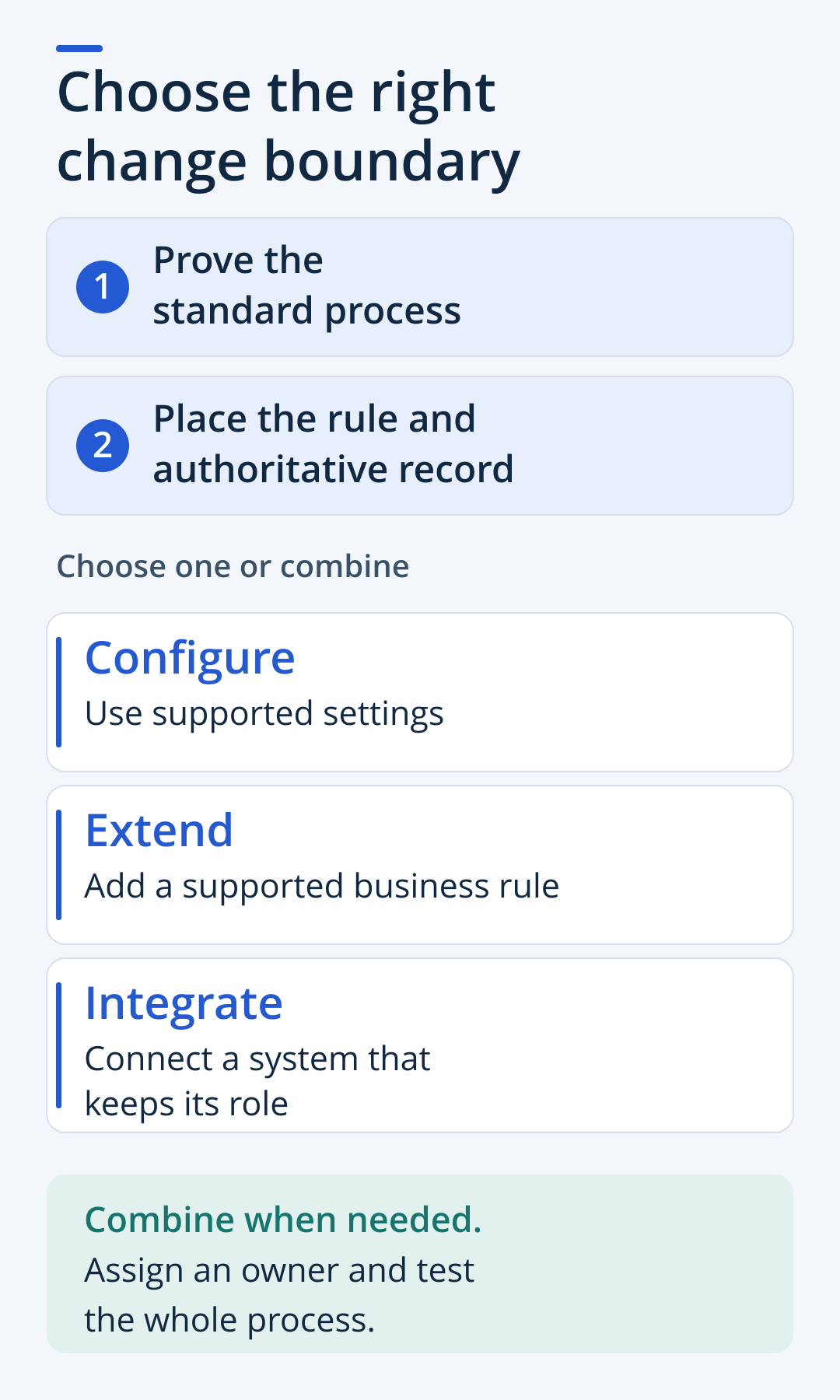
Start with standard fit. Then locate the business rule and authoritative record. Combine configuration, supported extension and integration when the process needs them.
Before approving development, ask the implementation team to demonstrate the standard process with one representative transaction and its difficult exception. That gives the business owner something concrete to accept or reject. It also separates a genuine product gap from an unclear policy, unfamiliar workflow or preference for an old screen.
Define the change before choosing the tool
“Customization” can describe anything from changing a screen label to adding a separate application. Ask for a more precise description in the proposal:
- Configuration uses the product’s documented settings, rules and options.
- A supported extension adds behavior through a mechanism the vendor documents for the selected product and release. It may use low-code tools or conventional code.
- Integration exchanges information or coordinates work between systems that remain responsible for their own functions.
The labels overlap. A low-code workflow can create a component that needs release management. A separate extension may depend on an integration. Microsoft’s Dynamics 365 extension guidance recommends trying application settings first and using documented extension patterns for code. This is useful guidance for assessing a gap, with capabilities still to be confirmed for the exact app, release and license.
Write the requirement as an outcome: “The order team can confirm a delivery promise only when the required dispatch conditions are satisfied.” Then identify the policy owner, records used, exceptions and evidence that would demonstrate success. Include this work in the agreed ERP implementation scope.
Compare what each option commits you to
Use this comparison as a planning aid. It does not prescribe a universal architecture or promise features in a particular ERP.
| Option | A useful reason to consider it | Evidence before approval | Ongoing responsibility |
|---|---|---|---|
| Configure | Standard settings meet the required outcome and the team can use the process | Demonstration of normal and exception cases in the selected version | Own the settings, access and tests after changes |
| Extend | A justified business gap needs additional behavior through a documented mechanism | Gap description, supported extension point, design and focused proof of behavior | Maintain the component and retest affected processes as releases change |
| Integrate | Another application should retain the function or authoritative information | Supported interface, record ownership, timing and behavior during failure | Monitor the connection and resolve incomplete or conflicting business outcomes |
The cheapest initial build is not necessarily the least expensive operating choice. Compare the same useful life and scope: subscriptions, implementation, test environments, monitoring, release testing, documentation, support and eventual removal. Ask which estimates depend on an unverified API, license or vendor component.
Microsoft’s application extension guidance places customizations within application lifecycle management and highlights maintenance, support and validation as updates arrive. A component built by a partner also brings that partner’s release cycle into the plan. Ask who will own each dependency before accepting the design.
Locate the rule and the authoritative record
Two questions help narrow the design:
- Must this rule take effect within the ERP transaction, before that transaction can complete?
- Which system is responsible for the fact the rule uses, and how current must that fact be?
If a rule must be enforced with an ERP transaction, examine the product’s documented extension options and transaction behavior. If the needed fact belongs to a separate specialist system, assess the permitted interface and what happens when its response is late, unavailable or no longer valid. Moving a rule outside the ERP creates a dependency that the design must address.
SAP’s Extension Use Case Patterns distinguishes on-stack and side-by-side approaches. Its guidance considers transaction consistency and proximity to ERP data for on-stack designs, and APIs, events and an independent lifecycle for side-by-side applications. These are SAP-specific options, not a feature map for other platforms. The buyer’s transferable question is whether the proposed location of the logic matches the required business behavior.
For a connection, document which system can create or change each important record. Our integration and data migration service scopes those interfaces, mappings and ownership decisions. Avoid leaving two systems free to revise the same business fact without an agreed conflict rule.
Work through one requirement, not a whole wish list
The following is a hypothetical planning example, not a client story or a statement of standard vendor functionality.
An industrial-parts distributor wants to offer dependable rush delivery before confirming an order. Its proposed requirement contains three different decisions.
1. Check the standard dispatch process
Ask whether the chosen ERP supports the required order cutoffs and dispatch calendars through settings. Demonstrate orders before and after the cutoff, a closed dispatch day and a corrected order. If the result meets the approved policy, document the configuration and the business owner’s acceptance. If a different standard process is acceptable, update the operating procedure rather than preserving an unnecessary gap.
2. Identify the distinctive rule
Suppose the distributor has an additional dispatch-eligibility rule that standard settings cannot express. The business owner must explain its value and define the exception precisely. The technical team then assesses a supported extension mechanism and whether it can enforce the rule at the required point in order processing. A proposal should identify what happens if the rule rejects the order, changes later or cannot be evaluated.
3. Obtain the external fact
Suppose the delivery promise also depends on a logistics provider’s collection slot. That availability belongs to the logistics service. An integration may be needed even if the ERP’s internal dispatch rules are configured correctly. Agree how long a returned slot is valid, whether a reservation is required and which response permits the order to proceed. If the service is unavailable, the business owner should choose an explicit outcome, such as holding the promise for review, subject to the available product and service capabilities.
This decomposition may justify configuration, an extension and an integration together. It can also show that one of the proposed additions is unnecessary. Keep the decision tied to demonstrated behavior rather than selecting a single label for the project.
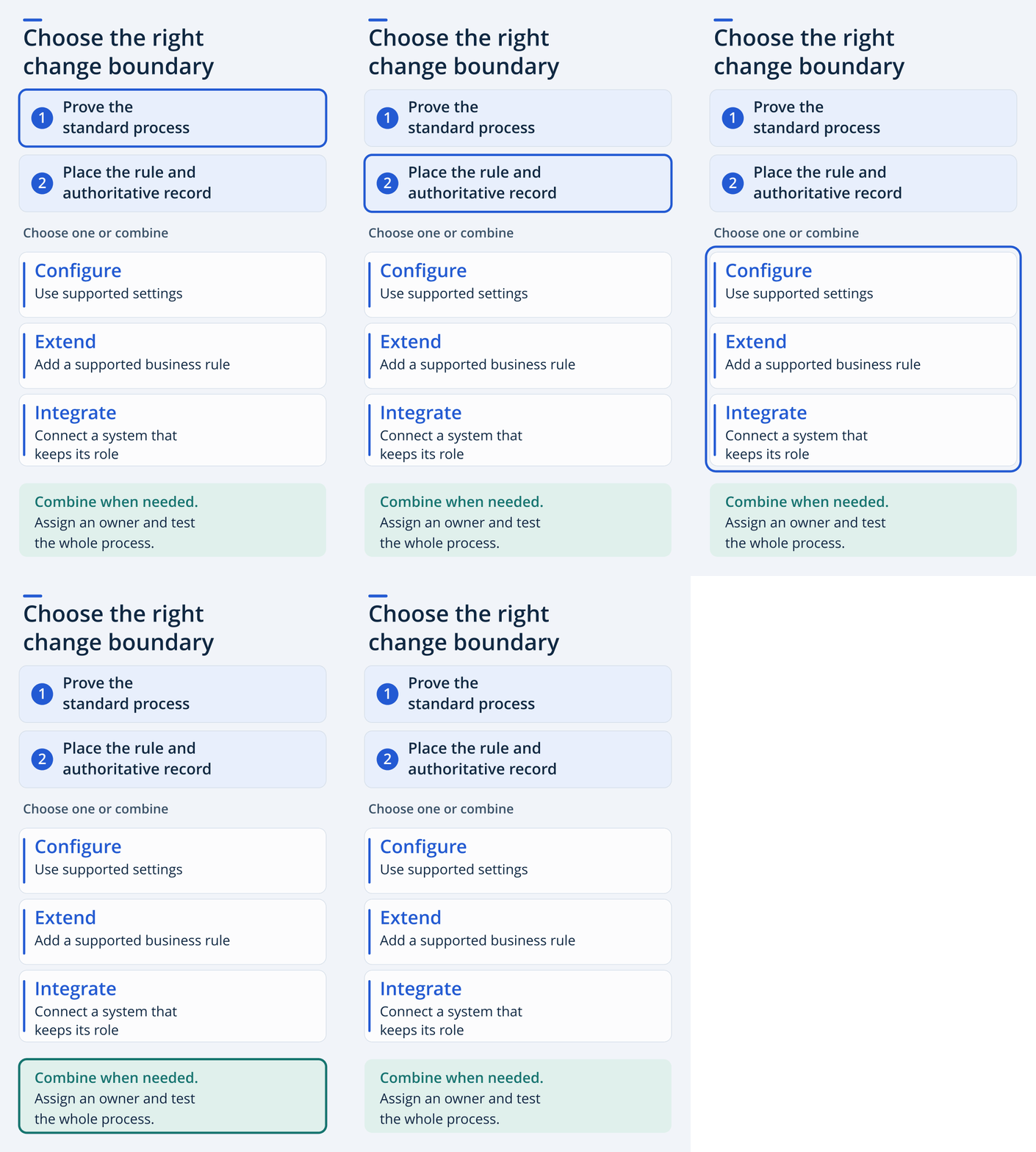
Follow the decision in order: standard fit, rule and record ownership, the right combination of options, then whole-process verification.
Ask for the failure and update story
A successful demonstration should be followed by questions about conditions that are harder to show:
- What if an external response arrives twice, arrives late or never arrives?
- How will staff identify an order whose technical message succeeded but whose business action remains incomplete?
- Which changes require retesting, and who supplies the test environment and sample records?
- Who fixes the component if its original developer is unavailable?
- What happens when the platform or an external service changes its interface?
- Can the added component be retired if a later standard feature satisfies the requirement?
Microsoft’s integration-pattern guidance discusses errors, repeated or out-of-order messages, recovery and monitoring. Our recommendation is to turn these concerns into observable business outcomes and named responsibilities in the decision record. A connector’s presence alone does not establish those outcomes.
Use the project’s agreed delivery phases and responsibilities to decide when evidence is due. A proof of concept can resolve a technical uncertainty; it should not silently become an unsupported production dependency.
Make bilingual and regional requirements explicit
For teams working in Arabic and English, record the same business rule in both languages before comparing solutions. Review labels, right-to-left layouts, reports, notifications, search behavior and reference data where they affect the task. Confirm actual language support for the chosen product and any added component.
Across entities or rollout countries, separate a shared rule from a genuinely local variation. Identify who approves the variation and the evidence behind it. Tax, payroll or other regulated requirements need appropriate local review. Do not turn a country name into an assumed need for custom code, and do not assume that a translated interface establishes local compliance.
Keep a short, reviewable decision record
Before committing to the change, ask the business and technical owners to agree:
- The required outcome, policy owner and representative exception
- The standard process demonstrated and the remaining gap
- The proposed configuration, extension, integration or combination
- The authoritative system for each critical record and decision
- The exact supported mechanism and unresolved version or license questions
- Acceptance evidence, failure behavior and release-testing scope
- The maintainer, support route, cost assumptions and retirement condition
Record the alternatives considered and why they were rejected. If an important dependency is still unverified, make that uncertainty visible in the approval rather than burying it in an estimate.
The Blue LED Global connects process design, platform configuration, integration, testing and training within an agreed implementation scope. To discuss a requirement, bring one workflow, the current system, the difficult exception and the person who owns the business decision. That is enough to start a focused fit-and-gap review.
Sources and review date
The comparison, decision record and hypothetical distributor example are editorial recommendations. Microsoft and SAP references describe their own products and architecture guidance. They do not establish identical features, licensing, language coverage or support terms across platforms.
Sources checked: 9 October 2026.
SAP citation updated and rechecked: 26 October 2026. The original source review date above is retained.
Sources
- Microsoft Learn: Customize and extend Dynamics 365 apps
- Microsoft Learn: Extend Dynamics 365 apps without compromising performance or security
- SAP: Extension Architecture Guide — Extension Use Case Patterns
- Microsoft Learn: Choose the right pattern for your Dynamics 365 apps integration strategy
- The Blue LED Global: ERP implementation services
- The Blue LED Global: System integration and data migration