ERP recovery drills: prove the business can work again

Sawsan Sayad
Sawsan Sayad covers enterprise systems, AI and business software for The Blue LED Global.
An ERP backup is ready for operational use only after a controlled recovery exercise shows that the right people can retrieve the required records, complete representative work and reconcile connected systems within the agreed recovery targets. A green backup job is useful evidence, but it is not the acceptance decision.
For an implementation team, the practical question is: what must finance and operations be able to do before we declare the system recovered? Define that answer before choosing the drill. The following worksheet is our proposed planning approach, not a report of a customer recovery or a promise about any vendor’s service.
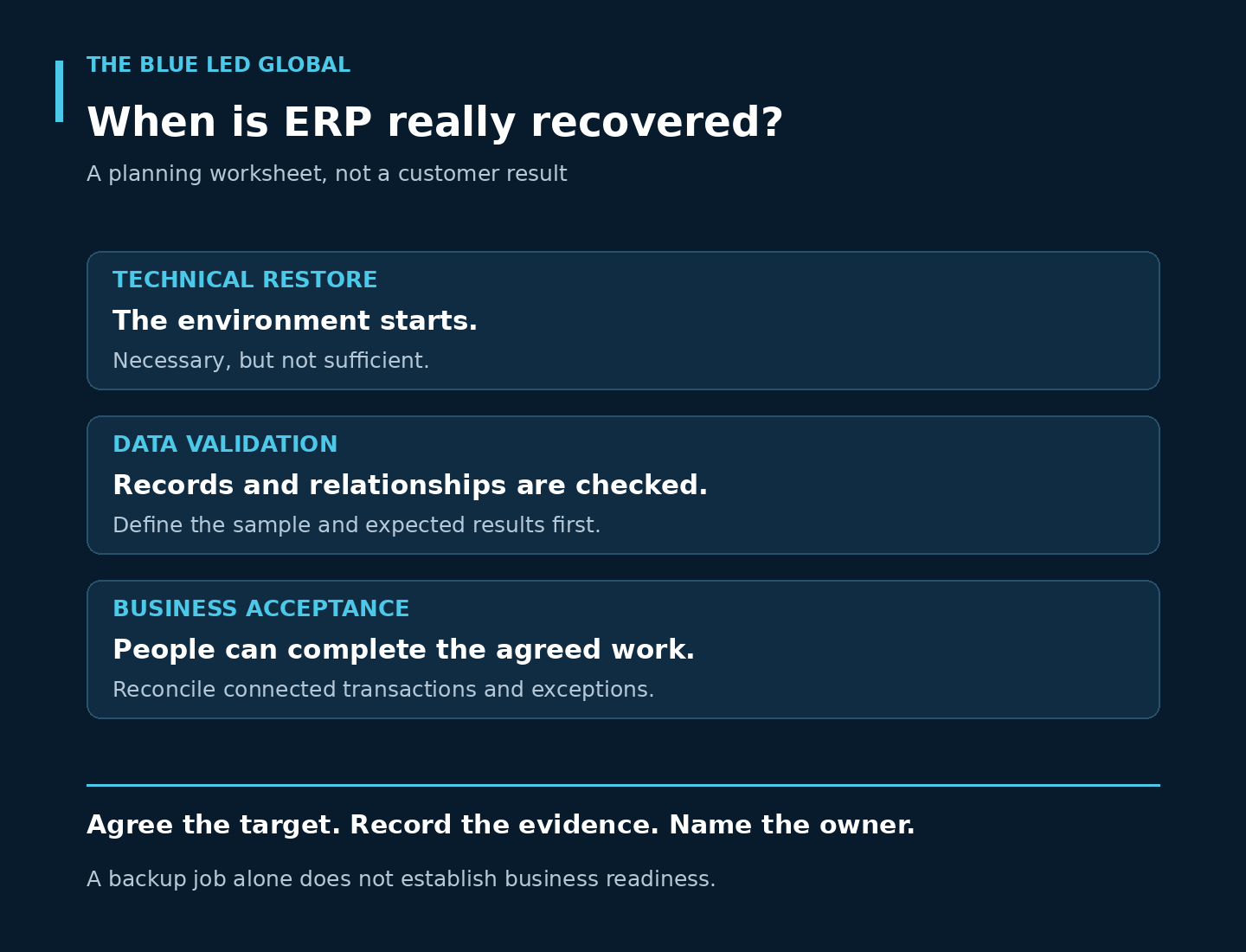
Proposed recovery acceptance layers: technical restoration, data validation and business acceptance.
Define recovery around a business process
Microsoft defines recovery time objective, or RTO, as the maximum acceptable time to restore business operations, and recovery point objective, or RPO, as acceptable data loss measured in time. Its disaster recovery guidance calls for plans covering both components and the overall system.
Translate those terms into a process-specific decision. For example, order entry may need a different recovery priority from a historical management report. Do not assign every application the same target merely because they share a hosting contract.
Record the business owner, minimum usable functions, acceptable missing period, dependencies and fallback procedure. State whether the recovery clock includes investigation, authorization, vendor response, restoration, reconciliation and business validation. Compare measurements with the agreed definition rather than a convenient technical milestone.
Separate the vendor’s recovery from yours
With SaaS, the customer may not control the underlying database restore. Ask the provider what can actually be recovered for the selected edition and contract: a whole environment, an individual record, an attachment, configuration, or a specific point in time. Record support hours, request authorization, retention and any restrictions. Do not infer these capabilities from a general uptime statement.
Our cloud, hosting and resilience service scopes vendor and customer responsibilities alongside recovery objectives. A useful responsibility matrix names who can request recovery, who executes it, who reconnects integrations and who approves the business result. Include a deputy and the contact route available outside normal working hours.
Choose evidence before starting the drill
AWS recommends periodically restoring backups and testing data accessibility and integrity against recovery objectives. It explicitly identifies restoring without querying the data as an anti-pattern. See AWS recovery-testing guidance.
Use the following proposed acceptance worksheet to turn that principle into ERP-specific evidence:
| Check | Evidence to retain | Decision owner |
|---|---|---|
| Recovery point | Backup reference, timestamp and latest expected transaction | Application owner |
| Business records | Selected orders, invoices and attachments open correctly | Process owner |
| Relationships | Documents retain the expected customer, company and line links | Data owner |
| Access | Intended roles can work; restricted roles remain restricted | Access owner |
| Connected work | Agreed handling of queued, missing and already completed transactions | Integration owner |
| Usable service | A representative workflow and relevant report complete | Business owner |
Agree the sample and expected results before the exercise. A few convenient records chosen afterward cannot establish that every record is intact. Combine targeted business checks with the broader validation mechanisms your platform supports, and state the limits of each check.
Keep the exercise from creating real transactions
Plan the drill in an authorized isolated environment with appropriate data protection. Before users test, identify outbound email, payment connections, order exports and scheduled automations that could affect production. Agree how those paths will be isolated or safely simulated using supported controls.
Do not treat a restored environment as harmless just because its database has a different name. Its configuration may still point to a live destination. The exercise plan should include a named technical owner who confirms the boundaries before business testing starts.
This article is a planning checklist, not an instruction to restore a live system or disable its controls. Recovery actions need the organization’s operational authorization and the platform’s supported procedure.
Reconcile the period between recovery and interruption
Hypothetical example: an ERP is restored to a point before an outage, while a connected order portal still contains later orders. The team must establish which orders are missing from ERP and which already produced an external effect. Replaying every portal message without investigation could repeat work; discarding the backlog could lose valid orders.
For the exercise, prepare an exception register containing source reference, ERP reference if known, status, evidence, next action and owner. Have authorized process owners decide corrections. This extends the controls described in our ERP integration retry guide; it does not assume that a restore resets every connected system to the same point.
Include attachments, reporting refreshes and pending approvals in the reconciliation scope when they matter to the selected process. Record exclusions explicitly.
Close the drill with a decision, not a screenshot
The result should distinguish technical restoration, data validation, business acceptance and remaining limitations. Keep actual timestamps, observed results, failed checks and the revised runbook together. If a target is missed, assign the corrective action and retest criterion instead of marking the exercise successful with a caveat hidden elsewhere.
For teams working across Lebanon and the Gulf, agree the decision owner’s availability and the language of recovery instructions. Test the handover to the people expected to use it, rather than relying on the person who wrote it.
Our testing, training and support service connects acceptance scenarios with operational ownership. Bring one critical process, the current vendor terms and the last recovery evidence to the review. The useful deliverable is a recovery decision your business can justify, with clear limits on what was actually tested.
Sources
Sources checked on 8 November 2026. Product-specific recovery rights and capabilities must be confirmed for the selected service and contract.